The Renaissance Innovator

Thoughts, examples and updates on the Renaissance Innovation Method

Back to school and more innovations

Posted on September 6, 2011


Evidently, we have been out for a while, preoccupied with long French summer… The good news is that most of our readers have been out as well, so no harm no foul. But it is good to be back to school and back to our blog.  In this first post of the new academic year I wanted to talk about a couple of recent innovations that I encountered in the popular press while on vacation, literally lying on the beach. While these stories are quite different, a common theme unites them: they are both about commodities. The reason they caught my eye is that I often teach for oil and gas companies (mostly Russian) and within INSEAD executive development programs we also often have a number of executives from the middle East (thanks to our Abu Dhabi campus). These and other participants often doubt that anything innovative can be done about their commoditized industries: the process of digging for oil, for instance, has not changed much, ever!  My answer is that ANY industry can innovate using our principles of the Renaissance innovation and here are a couple of examples.

Learning the Process of Renaissance Innovation

Posted on July 27, 2011


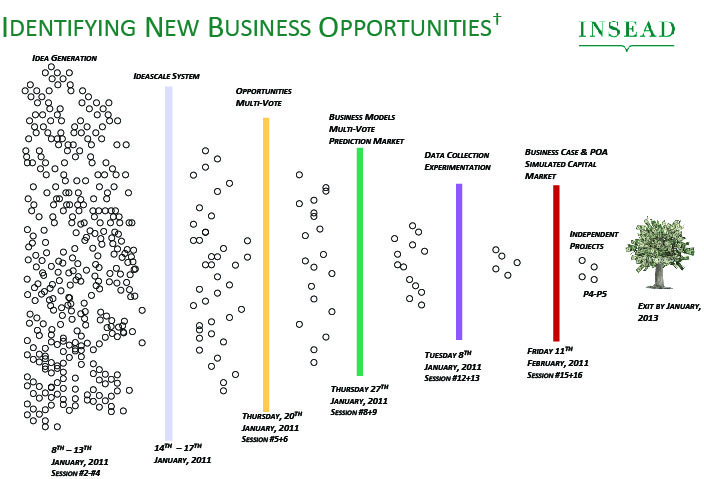
On this blog, we often share examples of firms that have successfully innovated their business model. While most find these examples inspiring, we  often get asked if there is a toolkit or a step-by-step way for firms to innovate themselves along these lines. In our executive teaching, managers routinely want to take “home” a toolkit so that they could transform their companies in the same way as Rolls-Royce did. Our MBA students, often ask us for techniques so that they could become Renaissance Entrepreneurs, a la Michael Dell or Amancio Ortega. This is exactly what we have been working on in our research– the renaissance innovation method.

Innovating the Innovation Process

Posted on June 26, 2011


We talk a lot about business model innovation on this blog. In previous posts, we have talked about firms that are innovating different elements of the business model- such as selling, staffing, promotions, etc. But what about the innovation function itself?- Can one innovate this part of the business model too?

Hypios, a company that I have worked with over the last few years is helping many firms do exactly that– change their business model for innovation… Read on to find out how…

The ultimate Internet retail innovator

Posted on June 11, 2011


Equating Amazon.com with innovation is a no-brainer.  The company has become the proverbial 800-pound gorilla of on-line retailing with nobody else even coming close. Amazon has built it business on books but over time it expanded into most other categories and it continues to dominate most of them.  Just like all other renaissance innovators, Amazon did not excel through creating new products (it sells what other do) or through new technologies (although Amazon leverages technology heavily, it is hard to argue that it invented Internet retailing). Rather, Amazon innovated the business model of selling goods through the Internet. Unlike what some believe, Amazon was not even the first company to sell books on the Internet but it was the one that figured out how to do it better by managing risks.

Renaissance Innovation @ INSEAD Knowledge

Posted on June 1, 2011


Check out  this  interview we did for INSEAD knowledge, our in-house business publication. The write-up and the companion video (embedded after the break)  summarize the key aspects of our theory of Renaissance Innovation and we answer some common questions related to the practice of Renaissance Innovation.  Regular readers of the blog will notice that we mention many of the example that we already blogged about here. We find that videos are  a great tool to liven up discussion in the boardroom or classroom, and we welcome you all to use the video to initiate the uninitiated…

Click through to see the video interview…

How to beat Amazon.com at its own game

Posted on May 24, 2011


 Who is the 800 pound gorilla in the Internet retailing? There is no question about it – Amazon.com.  The story of this company is, by itself, an excellent example of the renaissance innovation: Amazon.com thrives thanks in large part to the highly efficient supply chain management which allows it to deliver millions of products to the customers quickly and at very reasonable prices. One day I will write a separate post about it but today I wanted to blog about another company that was in the news recently because it was “what Amazon fears most” according to the Business Week magazine.  Amazon’s nightmare is apparently a relatively small Internet startup out of New Jersey called Quidsi, which is better known by its main business Diapers.com. This company was co-founded by my former student at Wharton Marc Lore, and its supply chain is run by my other former student and now VP of Operations Scott Hilton.  So why would a relatively small ($300M revenues in 2010) internet retailer threaten the Goliath ($32B revenues in 2010) to the point that Amazon.com decided to acquire it for $550M a few months ago?

Music to your Ears!

Posted on May 15, 2011


Record Labels  (and content creators, in general)  have  faced many storms over the last 15 years. With the movement to digital content and the industry’s slow and grudging  adaptation to it, the industry has basically had Apple and others steal its lunch. The traditional model of picking artists and investing big in them has failed to deliver the goods. But now,  a  pioneering Dutch company SellAband  is  challenging the traditional business models in this industry and hoping to reclaim some of the former glory– by changing the risks inherent in content creation businesses! How?

Restaurant leaderboards

Posted on May 6, 2011


Restaurant industry is probably one of the last places to look for innovations: the industry has not really changed much in the last 200-300 years. The same poorly paid waiters service the same customers and work for the minimal wage plus tips.  One relatively major change that happened some years ago is the introduction of POS (point of sales) systems which provide a wealth of data on everything that is going on in the restaurant: meals served, checks paid, tips earned etc.  Some of the better restaurant chains started using this data to schedule waiters according to customer demand to help simplify life of managers who used to allocate waiters to days and tables manually.  But there is a new, innovative workforce management solution out there which takes this game to a completely new level. It promises to dramatically increase productivity in the industry where productivity has not changed for ages.

GroupOn: Rebirth of the Coupon Book

Posted on May 2, 2011


Much has been written about the rapid growth and success of GroupOn. Every week seems to bring a new GroupOn copycat. And it is for good reason— No other startup has gone more quickly from launch to $1 billion+ in valuation except YouTube (12 months), which Groupon achieved in 16 months with its  $135 million infusion  in  April 2010. Just as unprecedented is what  followed  this valuation– after turning down an offer from  Google that valued it at $6 billion  last December, the Chicago firm is now eying a  US$25 billion IPO !

Some would explain this with the ready-to-explode bubble in startup valuations, and others say this is the impact of “Social”. While we see some merit in both arguments, we feel all that is written about Groupon has overlooked a key idea embedded in its innovative business model. We feel GroupOn is at least as much an application of renaissance innovation principles for managing risks of demand. Why?

How to Build Risk into Your Business Model

Posted on April 23, 2011


Check out our new article  in the May 2011 issue of the Harvard Business Review.  This is the first published preview of the theory behind  renaissance innovation.  The reader of the article will notice that, so far, our blog simply described in more detail,  the examples that appear in the article. As we have already hinted throughout this blog, the key behind successful Business Model Innovation is managing risks: in our view, all innovative companies we described in this blog have done the same thing right: they understood and managed the risk-return trade-offs in the design of their business model. This is, in our view, is a simple yet novel insight: all other works out there that study Business Models, typically focus on improving returns and completely ignore the associated risks.  This is a pretty big omission – it is quite clear that any business model out there is subject to many risks which may include demand, supply, technology, quality, asset utilization and many other risks. So how can a company innovate its business model through managing risks?